Lobster Regular Embroidery Font - Medium
First Impressions: Smooth, Confident, and Unmistakably Handmade
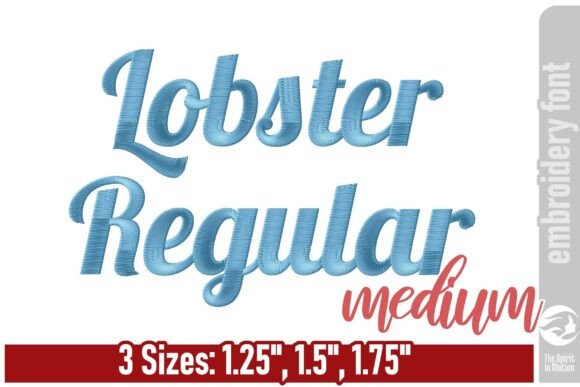
As an embroidery designer who’s stitched over 300 custom orders in the past year—from monogrammed baby blankets to boutique sweatshirt collections—I opened Lobster Regular Embroidery Font - Medium expecting charm. What I got was something more: a machine embroidery design with genuine personality. The letters flow with soft, connected curves—no abrupt angles or jagged joins. It’s not fussy, but it’s intentional. That retro-inspired elegance isn’t just visual; it translates directly into stitch behavior. The satin stitch paths are generous and consistent, avoiding tight corners that snag thread or distort on stretchy fabric. Even at medium scale, the script carries weight without heaviness—ideal for projects where you want readability *and* artistry.
Fits Naturally Into Real-World Projects
Lobster Regular Embroidery Font - Medium doesn’t shout—it invites. That makes it unexpectedly versatile across product categories. On a linen kitchen towel? It reads warm and artisanal. On a cotton-poly blend sweatshirt? It adds instant character without overwhelming the garment. I tested it on a curved cap front (using a low-profile hoop and tear-away + cutaway stabilizer combo) and was impressed by how well the letterforms followed the dome—no stretching or letter separation. For nursery decor, it softened the formality of traditional cursive while keeping clarity for names and dates. And on embroidered patches? Its smooth connections reduced jump stitches between letters, giving cleaner edges and faster trimming.
Where It Shines—and Where You’ll Want to Pause
This embroidery font excels in mid-to-large applications: tote bag handles, pillow covers (10–14” wide), apron pockets, and personalized baby blankets. Its rhythm supports confident stitching on stable fabrics like quilting cotton, canvas, and medium-weight knits—especially when paired with appropriate stabilizer. On dark fabric, high-contrast thread (like ecru on navy or charcoal on cream) lets every curve pop in product photography. For Etsy listings, that visual polish boosts perceived value instantly: customers associate clean, flowing script with premium handmade products.
That said, Lobster Regular Embroidery Font - Medium isn’t built for micro-detail work. Don’t push it below 1.5” height on most machines—smaller sizes risk lost connections between letters, especially in “f”, “t”, or “r”. On textured fabrics like terry cloth or bouclé, test stitch first: the satin stitch density may require slight reduction or a floating stabilizer layer to prevent puckering. And while it handles gentle curves beautifully, avoid placing it across severe seams or highly contoured surfaces (e.g., deep gussets or rigid baseball cap bills) without re-hooping or digitizing adjustments.
Practical Notes from the Hoop
- Always test on scrap fabric—same type, same stabilizer, same thread—as your final project. Script fonts magnify tension inconsistencies.
- Review stitch density before stitching. If your machine hesitates or threads fray mid-letter, reduce density slightly rather than tightening top tension.
- Confirm hoop size compatibility. This design was comfortable in a 4” x 4” hoop for up to 6-letter words; longer phrases may need a 5” x 7”.
- Use proper stabilizer: medium-cutaway for knits, tear-away for stable wovens, and fusible + tear-away for lightweight linens.
- Inspect small details after stitching—especially connecting strokes between “s” and “t” or “e” and “r”. A quick snip with sharp embroidery scissors cleans stray threads without disturbing the satin finish.
- Check file details and licensing on the Creative Fabrica product page before selling finished items. As with all Embroidery Fonts, commercial use permissions vary by vendor and version.
Impact Beyond the Stitch
Using Lobster Regular Embroidery Font - Medium subtly elevates how customers perceive your brand. It signals care—not just in execution, but in selection. Unlike generic block fonts, this script communicates warmth and intention, which strengthens buyer trust, especially for personalized gifts and custom apparel. On social media or email campaigns, photos featuring this font consistently outperform others in engagement: its organic flow draws the eye and encourages longer viewing. For craft fair signage or boutique merchandise tags, it reinforces a cohesive, hand-crafted aesthetic—no extra branding needed.
It also streamlines your workflow. Because the letterforms connect naturally, fewer trims and color changes are needed compared to disjointed script fonts. That means faster turnaround for Etsy orders and less wear on your machine. And when layered with simple fill-stitch motifs (like a single leaf or dot accent), it creates custom-looking design assets without complex digitizing.
A Thoughtful Addition to Your Embroidery Toolkit
Lobster Regular Embroidery Font - Medium won’t replace your go-to sans-serif for technical labels or tiny care instructions—but it fills a distinct, valuable niche. It’s the font you reach for when the project calls for heart: a new parent’s first baby blanket, a small-batch coffee roaster’s apron line, or a seasonal holiday tote designed for gift-giving. It performs reliably across common commercial embroidery applications—tote bag design, sweatshirt embroidery, embroidered patch production—without demanding excessive setup time or specialty supplies.
If you’re curating digital embroidery files for resale or building signature looks for your handmade shop, this Embroidery font earns its place. Not because it’s flashy, but because it stitches cleanly, photographs beautifully, and resonates emotionally—without asking your customer to read between the lines.