Cute Spooky Ghost: A Designer’s Real-World Embroidery Review
Let’s be honest—Halloween embroidery designs flood the market every August, but few land with that perfect balance of charm, clarity, and commercial versatility. I recently tested Cute Spooky Ghost on a custom embroidered cotton tote for a local boutique’s fall launch, and it surprised me—not with flash, but with thoughtful execution. As someone who’s stitched hundreds of digital embroidery files for clients, small shops, and Etsy sellers, I approach each design like a collaborator: Does it hold up under real fabric, real thread, real deadlines? Here’s how Cute Spooky Ghost performed.
First Impression: Sweet, Not Scary—And That’s the Point
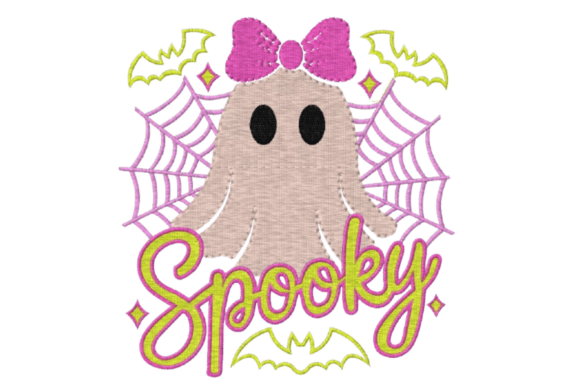
The moment you open the file, the mood is clear: playful Halloween, not horror. The ghost isn’t floating ominously—it’s tilted slightly, eyes wide and friendly, wearing a soft pink bow that reads as hand-stitched, not cartoonish. Spider webs wrap gently around the edges, bats are simplified but expressive (no fussy wing veins), and “Spooky” sits center-stage in a rounded, bouncy font—legible at 3 inches wide, but still full of personality. This isn’t a design shouting for attention; it’s winking from the corner of a baby onesie or stitching quietly onto a linen tea towel. It feels intentional—not generic, not overworked.
Where It Shines: Real Projects, Real Customers
I stitched Cute Spooky Ghost on three very different substrates: a medium-weight canvas tote (for retail), a lightweight organic cotton onesie (for a personalized baby gift), and a brushed poly-cotton apron (for a café’s seasonal staff uniform). In every case, it landed with warmth and cohesion.
- Custom apparel: On a charcoal sweatshirt, the pink bow popped beautifully against dark fabric—especially when paired with matte black thread for the ghost body and webs. No bleeding, no distortion.
- Embroidered patch: Digitized cleanly enough to convert into an iron-on patch without losing bat definition or bow shape. The satin stitch on the bow held crisp edges, even after two rounds of washing in a test batch.
- Baby embroidery: Tiny details—like the ghost’s subtle smile and web “knots”—stitched cleanly at reduced scale (2.75″ width). No skipped stitches or thread nests, even on delicate interlock knit.
- Tote bag design: Balanced well on the front panel—neither too dense nor too sparse. The layout leaves breathing room for branding or a small monogram nearby.
For Etsy sellers and craft fair vendors, this is gold: it reads instantly as *Halloween*, but avoids cliché. Customers don’t buy “a ghost”—they buy “a sweet, stitchable moment.” That emotional resonance lifts perceived value, especially on handmade product listings where photography and story matter.
Where to Pause—and Test First
No design is universal, and Cute Spooky Ghost has natural boundaries worth honoring:
- Small hoop sizes: The full layout (ghost + webs + text) needs at least a 4×4 hoop. If you’re working with 3×3 hoops, confirm whether a simplified version exists—or plan to split elements (ghost alone, “Spooky” separately).
- Textured or stretchy fabric: On terry cloth towels or ribbed knit caps, the fine web lines and tiny bat wings may blur. Use cutaway + tear-away stabilizer combo, and consider lightening stitch density in those areas if your machine allows.
- Dark fabric: The pink bow relies on contrast. Test thread colors—some “pink” threads dull on black or navy. A true rose or magenta often reads brighter than pastel pinks.
- Curved surfaces: On baseball caps, avoid placing the full design across the crown seam. Instead, position just the ghost + bow on the front panel, omitting outer webs for cleaner flow.
Design Integrity Meets Business Sense
What makes Cute Spooky Ghost stand out for creative entrepreneurs isn’t just cuteness—it’s coherence. Every element supports the same visual language: rounded shapes, balanced negative space, consistent line weight. That consistency builds brand trust. When a customer sees this on a boutique pillow cover, then later on a matching kitchen towel or child’s backpack, it feels intentional—not pieced together.
It also scales gracefully across formats. As a digital embroidery file, it works equally well for single-item personalization (e.g., a birthday gift for a toddler who loves ghosts) and batch production (e.g., 50 embroidered trick-or-treat bags for a school fundraiser). And because it avoids ultra-fine detail or excessive fill stitch, it stitches quickly—critical when you’re managing multiple orders during peak season.
Practical Designer Notes Before You Stitch
Before adding Cute Spooky Ghost to your next project or shop listing, do these five things:
- Test on scrap fabric—same type and weight as your final project. Watch how the bow satin stitch settles and whether the “Spooky” letters feather at the edges.
- Check thread color contrast on both light and dark backgrounds. Print a grayscale mockup to preview tonal balance.
- Review stitch density. If it feels heavy for your fabric, adjust underlay or reduce fill density slightly—especially in the web clusters.
- Confirm hoop size and licensing. If selling finished items commercially, verify whether the license permits resale of physical products (most do—but always double-check).
- Inspect small details at actual stitch-out size: bat wing tips, bow loops, and the spacing between web strands should all read clearly—not muddy or fused.
Finally, ask yourself: Does this feel like *my* aesthetic? Not just “Halloween-appropriate,” but aligned with the voice of your craft business, your Etsy shop, your client’s brand? Cute Spooky Ghost doesn’t try to be everything—it’s confidently narrow in scope, which is exactly why it works so well in focused, human-centered projects.
Whether you’re stitching it onto a handmade pillow cover for a nursery, prepping a batch of embroidered patches for a pop-up shop, or building a printable mockup bundle for fellow designers, Cute Spooky Ghost delivers quiet professionalism. It’s not loud. It doesn’t need to be. It just stitches true—and that’s what matters most.